

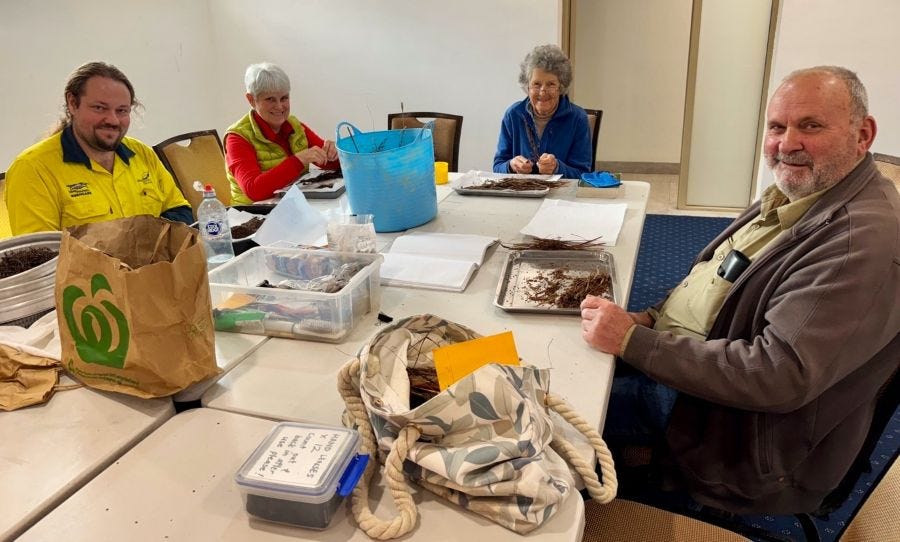
From Left to Right: Sean Moore (Bushcare Officer), Maree, Meredith, Ian
There’s a small group of passionate Blue Mountains Bushcarers who meet monthly to collect and clean local native seed. We met up with them to find out how and why they cooked Banksias to release seeds, how they cleaned the seeds of a variety of different Gahnia species, and why they love being part of the Bushcare Seed Collectors Group.
Key Points:
The Bushcare Seed Collectors meet from 10am to 3pm on the second Tuesday of every month. Contact Blue Mountains City Council Bushcare Office to learn more.
Approval must be obtained, preferably in writing, where seed and other propagation material is collected from land belonging to another landowner, whether private or public (e.g. Commonwealth, Crown, National Park, State Forest, local council), or Aboriginal land.
Visit the Department of Climate Change, Energy, the Environment and Water website to learn about the licences that are required to collect seed from threatened species and protected native plants.
Collecting and propagating native seed requires extensive knowledge about how native plants regenerate. One way to learn how to do this is to join the Blue Mountains Bushcare Seed Collectors Group: a warm and friendly group of locals who love plants and learning more about them, and who are motivated by knowing that their work will provide the fresh local seed needed to regenerate degraded areas, create habitat for wildlife, and protect the health of our bushland.
Veteran Bushcarer Ian Power, who also volunteers with the Planetary Health Bushcare Group on the first Saturday of the month, loves the diversity of activities that the Seed Collectors Group offers: “You do reconnaissance, you go out to areas to look for potential sites to collect seeds, or to check to see if plants are ready to have seeds collected. We also recover plants. A good example: when the council might be repairing a walking track and we can collect plants on either side of the track and then they’re grown on. And the other thing is to collect seeds and sometimes we just go out and do a lovely bushwalk, having a look. Which is my favourite day!”
The group can meet in various locations across the Blue Mountains but they’re also often at the Planetary Health Centre, as they were recently, when we interviewed them about cooking Banksias to release their seeds.
Learn how they do it in this video:
If you’d like to join the group, contact the Bushcare officer Tracy Abbas on 4780 5623 or email tabbas@bmcc.nsw.gov.au
These Conservation Management Notes were prepared by the NSW Government Office of Environment & Heritage, supported by Caring For Our Country
Managing bushland and wildlife habitat
Seed collecting in bushland and wildlife habitat
This note is for landowners wishing to collect native seed for revegetation projects on their land. Collection, cleaning and storage methods are outlined, as well as guidelines for ethical and sustainable collection.
Collecting sustainably and ethically
These guidelines will help protect the source area when seeds and other material, (such as underground stems, fern spores and cuttings) are being collected:
• avoid unnecessary damage (e.g. trampling of understorey plants)
• ensure nesting sites, tree hollows or other animal habitats are not disturbed
• do not remove more seed or plant material than is required
• do not remove more than 20 percent of the fruit from any one plant
• do not take more than 10 percent of plant material from any one plant (larger seed quantities should be obtained by collecting from more plants)
• avoid bringing weeds into the collection site by cleaning shoes, collection equipment, etc
• take particular care when collecting from rare or threatened plants — if collecting may put a local population of a species further at risk, it may be better not to collect at all.
Leave plenty of seed behind in the environment — it doesn’t go to waste if not collected
Native seed is a valuable resource, not only for seed collectors and plant propagators, but also for the plants that produce it, and for the native birds, mammals and insects that feed on it.
Native vegetation needs a healthy seedbank to continually regenerate, and to recover from disturbance such as fire. The seedbank is made up of seed still on the plants and seed that has dropped and is stored in the soil. Excessive removal of seeds from an area that is being left to regenerate could jeopardise plant recovery.
It takes a large number of seeds to produce a mature plant — many seeds and seedlings are eaten, or fail to find the right growing conditions to survive to maturity.
Minimise the amount of seed taken from the bush:
• plan ahead — have an idea of how much seed is required for each species and don’t collect more than necessary
• ensure revegetation works include good site preparation and maintenance, so that seedlings are not lost — be particularly careful with direct seeding as this method can be very wasteful of seed if not well managed
• for each species, find out how much seed a typical fruit contains, e.g. a eucalypt gumnut can contain hundreds of seeds, while a banksia cone may contain just a few
• avoid collecting immature seed
• clean and store seed promptly after collection — if it is not sown straight away, it may rot
• store seed properly in cool dry conditions so it stays viable for as long as possible.
Permits and licences
Where seed and other propagation material is collected from land belonging to another landowner, whether private or public (e.g. Commonwealth, Crown, National Park, State Forest, local council), or Aboriginal land, approval must be obtained, preferably in writing.
Licences are always required when collecting from:
• threatened species, populations and ecological communities listed under the NSW Threatened Species Conservation Act 1995, and the Commonwealth Environmental Protection and Biodiversity Conservation Act 1999
• schedule 13 Protected native plants under the National Parks and Wildlife Act 1974.
Where to collect seed
It is generally best to match environmental conditions (such as ridgetop, floodplain, clay or sandy soil) at the planting site with those of the collection site.
In extensively cleared areas, roadsides, stock routes and reserves may have the greatest diversity of indigenous plants, and so can provide a good seed source for revegetation projects.
Collecting from planted vegetation should be avoided unless its original source is known with certainty.
Using local material
Local seed is also described as indigenous to the area or of local provenance.
The use of local native seed and other propagation material retains any unique characteristics of local genetic populations, which may be important for their long-term survival.
Care needs also to be taken not to encourage too narrow a gene pool, as this may also affect the long-term survival of a species. This needs consideration if species being collected are present in low numbers.
How local is local? It is rarely possible to be precise about distances, but an indication may be gained from how far a plant species disperses its seed and pollen. This varies for each species. Fleshy fruits of rainforest trees may be carried a long way by birds and bats so it may be appropriate to source them from anywhere within the region, while the drier seeds of peas and wattles will not travel far from the parent, and the collection range may need to be more narrow — but not so close to a small revegetation site that there is a risk of inbreeding.
The Florabank guidelines (www.florabank.org.au) provide more detail.
The practicalities of seed collection
Seed collection involves five separate processes: obtaining approvals and permits, collecting seedbearing fruit, extracting seed from the fruit, storing the seed to ensure maximum long-term viability and, depending on the project, recording what has been collected.
Ways to maximise the genetic quality of seed collected:
• collect from a wide range of plants — at least 10 of each species is recommended
• include plants that may not appear ‘perfect‘ specimens (such as crooked, gnarly trees), but avoid diseased plants
• collect from specimens scattered throughout the source patch rather than from adjacent specimens, which may be closely related (choose plants separated from one another by a distance of at least twice the plant height)
• avoid collecting seed from isolated plants unless it is combined with seed from other local plants (seed from isolated paddock specimens are likely to be less viable as they may be inbred from self-pollination)
• keep a record of from where and from how many parent plants seeds are collected.
Methods of collection
One of the best ways of collecting from tall trees is by taking advantage of fallen limbs and branches, provided it is clear which species they came from (e.g. there may be more than one eucalypt species present) and the seed has not already been released. A long-handled pruner used from the back of a truck may be adequate to reach lower branches.
Fruit on small trees and shrubs can be cut with secateurs or pruners, hand-picked, or the branches hand stripped. A drop-sheet or tarpaulin under the plant can be used to catch fallen seeds and fruit when branches are shaken.
For species which release their seed very quickly upon ripening (such as wattles and bush-peas), it may be worthwhile to tie paper bags or nylon stockings around the branches before the seed pods ripen.
Recognising mature fruit
In eucalypt forests and woodlands, seed of most native plants is found in woody fruits, whereas many fruits in rainforests are succulent. It is important to ensure that the fruit is ripe when picked, as unripe fruit contains immature seed.
Some species release their seed immediately after ripening, while others retain their seed for years.
Plants of the Fabaceae family (wattles and peas) are some of the quickest to release their seed, so timing is critical. The pods which contain the seed generally change from green to brown upon ripening.
Other species retain their seed on woody fruit on the plant for a year or more, e.g. Eucalyptus, Melaleuca, Leptospermum, Callistemon, Callitris (cypress), Casuarina and Allocasuarina (she-oaks) and Banksia. The fruit of these species change from green to brown or grey at maturity.
Many plants found in rainforests have fleshy berries. Berries often change from green to another colour and become soft when mature.
Drying
Before seed can be extracted from woody and other non-succulent fruit, it needs to be dried. It should be stored in a warm, dry, well-ventilated place free from seed-eating insects, mice and birds. Plastic sheets or tarpaulins may be appropriate for larger quantities, while paper bags are generally good for smaller quantities. It is vital that the drying environment isn’t so humid that the fruit or seed becomes mouldy. It is also vital that different batches of seed don’t mix together in the drying process — wattle pods, for example, ‘explode’ when they open, ejecting their seed some distance.
Seeds enclosed in a fleshy fruit may be soaked in water so that the fruit will ferment and separate from the seed. Separation can be hastened by manually pressing the fruit. Viable seed settles to the bottom of the container, while the pulp rises to the top or is suspended in the water. Some species require chemical separation of the flesh from the seed. Typically, the seed of fleshy fruits should be sown soon after the flesh is removed.
Some woody-fruited species such as Banksia ericifolia require high temperatures to release their seed.
The cones can be placed in an oven at 80–100°C for 30 minutes, with the door partially open. The valves should open, if not, they can be left in the oven until they do.
Cleaning and extracting
After drying, the seeds can be separated from the fruit or other debris by shaking, sieving or winnowing.
The seed should now be adequately clean, dry and ready for storing.
Storing and recording
A good storage system will help retain seed viability and protect it from insects, mice and birds.
The ideal container is clean, dry, vermin proof and has a good seal. Each container should contain seed from only one species. Containers should be labelled with species name, collection site, collection date, collector’s name, and the number of parent plants from which the seed was collected. It may be desirable to add other information, depending on the project.
The optimum conditions for storing seed is in a fridge with a temperature of 1–5°C and a relative humidity of 4–8 percent, both with minimal fluctuations. When seed is not stored in a fridge, a sachet of silica gel crystals may be placed in the container (e.g. paper bag) to keep it dry.
Eucalypt seed has been known to remain viable for 20 years when stored at 4°C. Most seed can, however, be stored at room temperature (10–20°C) for several years, although with some loss of viability.
Useful references
The primary resource recommended is:
FloraBank www.florabank.org.au (the national FloraBank program contains 10 guidelines covering all aspects of native seed collection, collection ranges, cleaning, storage and recording, as well as other information).
Other resources
BRAIN 1996, Seed collecting workshop, Brisbane Rainforest Action and Information Network, www.brisrain.webcentral.com.au/01_cms/details.asp?ID=278
Department of the Environment and Heritage 2004 Be smart with seed https://www.environment.gov.au/land/publications/native-seed.html
Ralph M 1993, Seed collection of Australian native plants for revegetation, tree planting and direct seeding, Murray Ralph Sweedman L & Merritt D (eds) 2006, Australian seeds: a guide to their collection, identification and biology, CSIRO Publishing
The information above was originally published Office of Environment and Heritage, Department of Premier and Cabinet NSW.
59–61 Goulburn Street, Sydney
PO Box A290, Sydney South 1232
p: 02 9995 5000
e: info@environment.nsw.gov.au w: www.environment.nsw.gov.au
ISBN 978 1 74293 318 4 OEH 2011/0661
Key sources are:
1: Sheahan M (ed) 1998 VegNotes 3.2 Seed collecting Murray Catchment Management Committee and Department of Land & Water Conservation
2: Brodie L, & Ondinea D 1997 Seed Collection from bushland reserves, Native Seed Savers News, Winter 1997.
Other sources include the references listed and contributions from various individuals.
Take Action:
If you’d like to join the group, contact the Bushcare officer Tracy Abbas on 4780 5623 or email tabbas@bmcc.nsw.gov.au
Volunteer with the Planetary Health Bushcare Group on the first Saturday of the month
Learn more about native seed collecting at https://www.florabank.org.au/