

Every weekend, there’s a market on somewhere in the Blue Mountains. And at each market, people are enjoying the local food and drinks on offer as they browse the local produce, arts and crafts, hand-made clothes and vintage wares. It’s a lovely way to spend a few weekend hours. But at the end of each market, what’s left behind is several bins full of rubbish and food waste heading straight to landfill.
This would come as a surprise to many market goers. After all, most food containers and take-away coffee cups claim to be recyclable, and people are getting better at using recycling bins when they’re available. But for reasons we’ll discover, almost all of it goes to landfill anyway.
That is the problem Blue Mountains City Council (BMCC) is taking on with a new initiative based on an old-school idea: instead of throwing away cups, plates and cutlery after a single use, wash them and use them again.
BMCC has recently acquired a mobile wash trailer as part of its Towards Zero Waste Events project, creating a reusable serving-ware system that can travel to markets, festivals and other community events across the Blue Mountains and beyond.
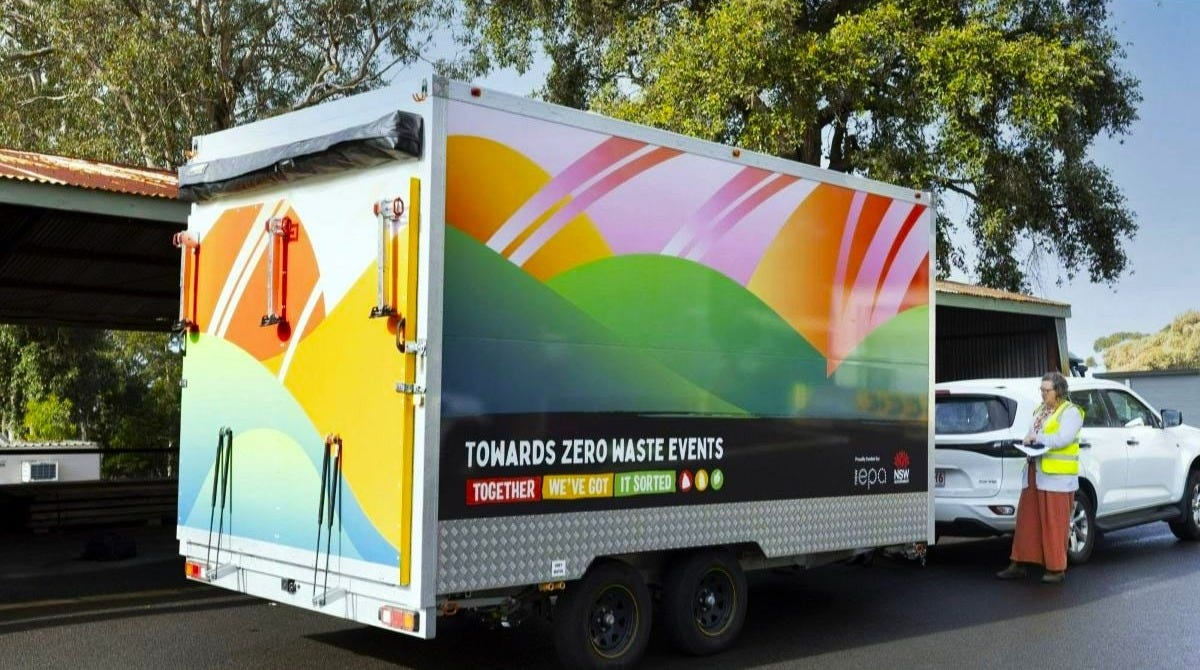
Blue Mountains City Council’s new mobile wash trailer
The project is supported by a grant from the NSW Environment Protection Authority’s Local Government Waste Solutions Fund.
From bush regeneration to circular systems
For Erin Hall, the Senior Circular Economy Project Officer at BMCC who has led the initiative, the idea has been a long time in the making. I met with her over coffee at 1Two1 café in Springwood to learn more.
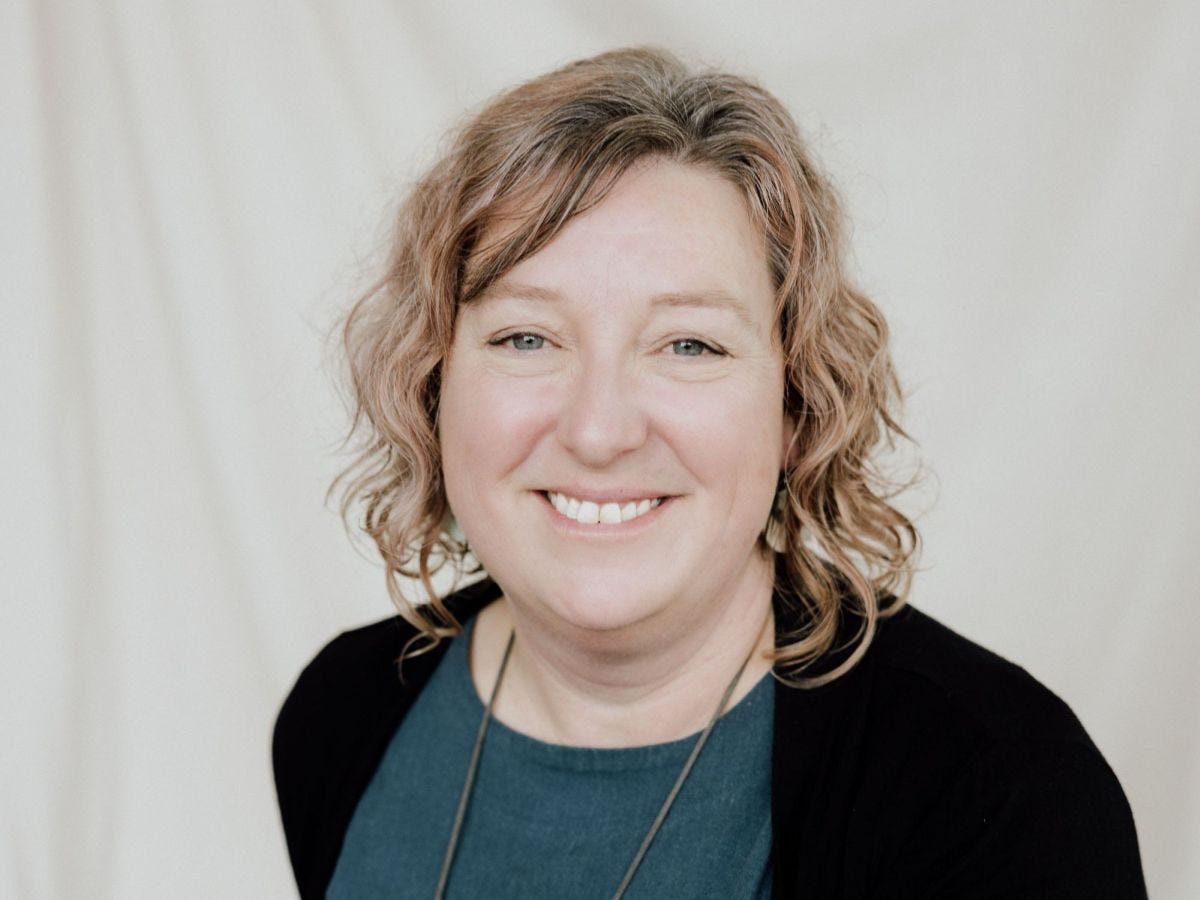
Erin Hall, BMCC’s Senior Circular Economy Project Officer
Erin came to waste management from a science background, initially studying biology before moving into bush regeneration. What attracted her to that work was its practical nature. “I like getting things done, and seeing the fruits of my labour”, she says.
For about ten years she also worked as a casual waste educator, talking to Blue Mountains residents about recycling and resource recovery, and learning how people think about these things and how their behaviour can be shifted in the right direction.
Her current role includes implementing BMCC’s upcoming FOGO (Food Organics & Garden Organics) service, but the circular economy component of her work is what led her to the wash trailer idea.
The circular economy
The philosophy is straightforward: rather than treating everything arriving at a waste facility as rubbish, ask whether it can be reused, repaired, recycled or otherwise kept in circulation.
That philosophy is embedded in BMCC’s Towards Zero Waste program, which focuses on reducing waste along with helping the community reuse and recycle items. This led Erin to do a deep dive into what other local councils and community groups were doing to tackle the event waste problem, and what she found gave her some powerful inspiration.
She discovered successful wash trailer systems operating in New Zealand, as well as initiatives in Byron Shire, Mornington Peninsula and Jindabyne in the Snowy Mountains. She then began talking to local market organisers and vendors about what would actually work locally in the Blue Mountains.
It was not an overnight project. Erin says the idea had been developing for around six years, including trial runs with reusable dishes at a local market and seeing first-hand where the barriers were.
By the time the EPA grant opportunity arrived, the relationships had been built, the problems understood and a workable system could be proposed.
The scale of the throwaway problem
The numbers explain why all this effort is worthwhile. At one Blue Mountains market, BMCC’s audits consistently found a 60-litre bucket full of food waste was created, mostly leftovers and plate scrapings.
There were also typically four to six full wheelie bins of general waste at a market with around 10 food vendors, with the town centre bins filled with waste containers from the market.
Then there were the coffee cups. A typical Blue Mountains market can go through around 600 disposable coffee cups per day. BMCC estimates that across five regular monthly markets, replacing single-use cups alone could avoid up to 96,000 disposable cups going to landfill per year.
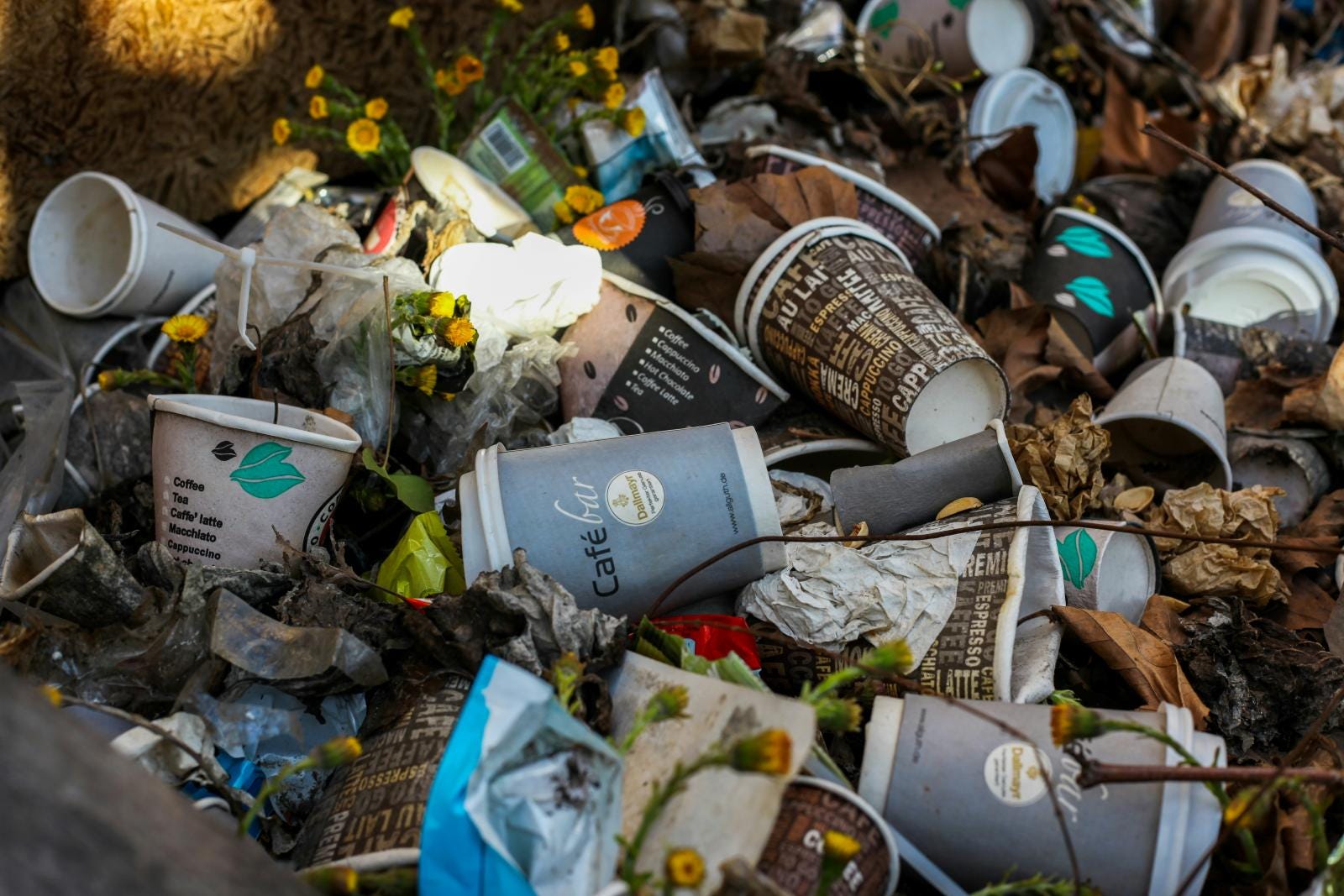
Disposable coffee cups going to landfill. Photo by Jas Min via Unsplash
Appearances can be deceiving
The particularly frustrating thing is that many of these products claim to be recyclable or compostable. In practice, most of them are not. A recent study by the EPA looked at the chemical risks and compost-ability of a range of supposedly compostable single-use food service items.
They tested for contaminants such as per- and polyfluoroalkyl substances (PFAS), phthalates, plastics and heavy metals. PFAS was found in a third of the products, and many items had non-compostable lids or liners as well as containing plastic-based inks, dyes and adhesives.
Food-contaminated cardboard containers cannot simply go into the recycling bin. And even disposable coffee cups are problematic. As Erin explains, the cup with its plastic lining, along with the coffee-coated lid, can’t be recycled so it ends up in landfill.
The result is a familiar cycle: resources are extracted, manufactured, packaged in virgin cardboard (recycled cardboard can’t be used for food service packaging), transported to an event, used for perhaps 15 minutes, then binned, transported to a waste facility, and buried as landfill.
The wash trailer is designed to break that cycle.
A mobile dishwashing service for events
The trailer is essentially a commercial dishwashing operation on wheels.
BMCC has stocked it with reusable cups, plates and cutlery, allowing food and drink vendors to serve customers without buying disposable items for each event.
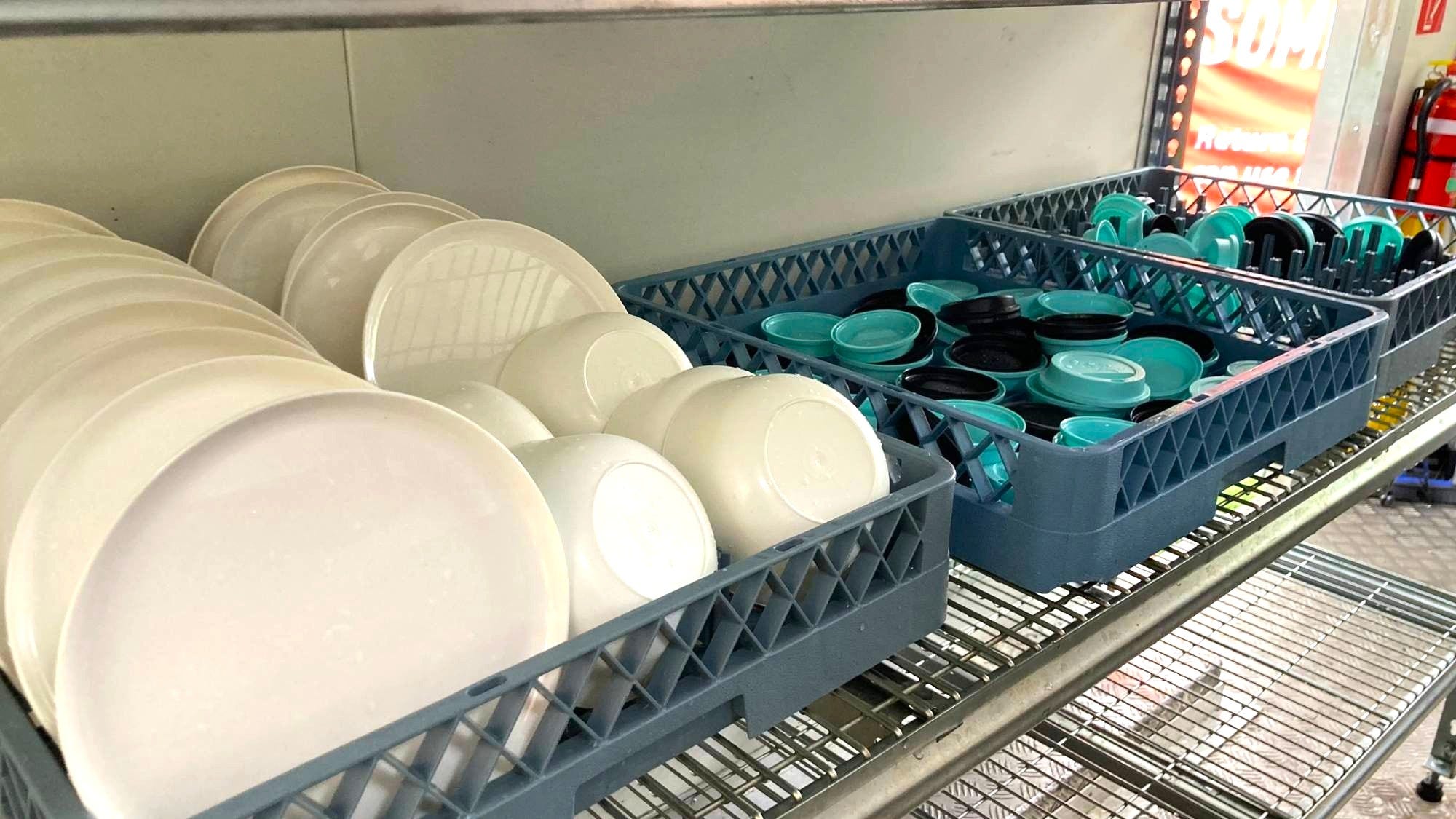
Reusable plates, bowls and coffee cups washed, sterilised and ready to be used again
The heart of the system is a commercial dishwasher and steriliser capable of processing a tray of dishes in about three minutes.
The use and re-use process is simple. Customers use their cup, plate or cutlery and then return it to highly visible collection points. Here, food scraps can be scraped into a dedicated composting bin, while cups, plates and cutlery are placed into their own receptacles.
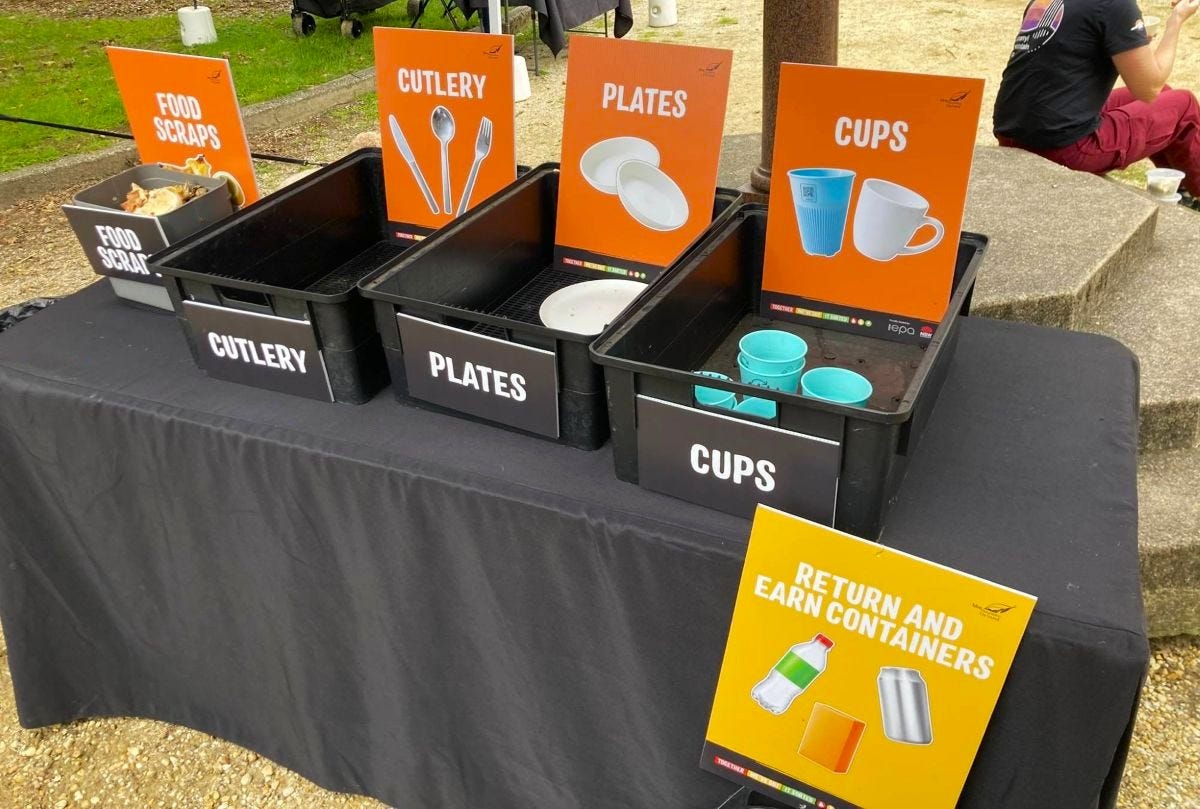
One of the collection points for reusable serving ware and food scraps at a recent market
A trolley collects the used serving ware and brings it back to the trailer, where it is washed and sterilised before being returned to vendors.
The aim is that, when the market closes, there is dramatically less rubbish. What remains is primarily food organics that can be composted and a small amount of other material that cannot currently be diverted.
Market visitors can enjoy their coffee knowing that the cups are BPA free and have been tested to over 1000 commercial wash cycles, meaning that each cup can prevent 1000 disposable cups from going to landfill over its life span. And once they reach the end of their life, they are 100% recyclable.
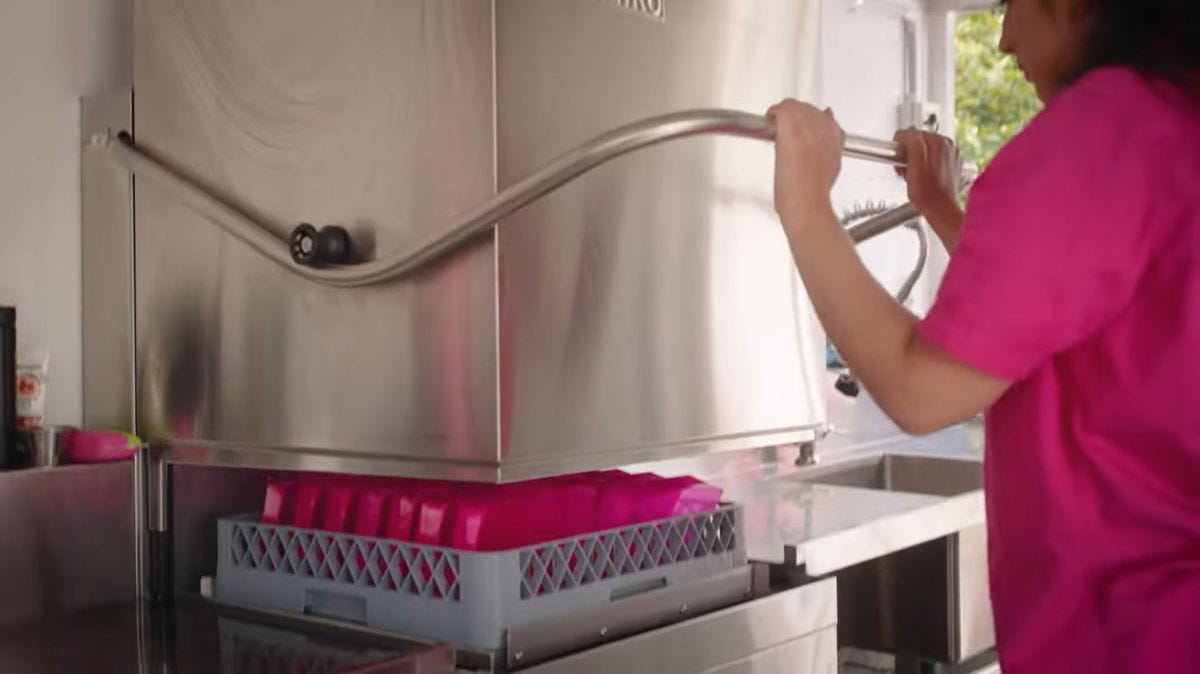
Another load of clean plates ready to go. A wash cycle takes just 3 minutes.
Food waste becomes a resource, not a risk
Rather than food scraps being mixed with general rubbish and buried in landfill, they are separated at the event, ready for food organics processing.
That becomes particularly significant as BMCC prepares to introduce the FOGO (Food Organics & Garden Organics) system in 2027. Erin says getting food waste out of landfill will bring major environmental benefits because organic material buried without oxygen produces methane, a potent greenhouse gas.
Making reuse easy
An important part of Erin’s approach is that she is not expecting people to become perfect environmental citizens overnight; she has designed the system around how people actually behave.
At the trial events held earlier this year, waste stations were placed where people naturally expected bins to be. Signage showed where used serving ware and food scraps should go. Customers took to it right away but to begin with, some vendors were initially reluctant to participate. However, once customers started asking those vendors for re-usable containers, their attitudes changed.
It was easy for the customers to use, and the vendors soon discovered that it was easy for them too, as well as saving them money by not having to buy the single use food and drink containers.
That’s important because the success of a system like this depends less on persuading every individual customer to make an environmentally perfect choice and more on making the sustainable choice the easiest choice.
A model other councils could copy
Event organisers can hire the trailer via an online booking form, with Council initially keeping the cost low at just $110 per day, and working through the process of delivery, setup, food-safe operation and staffing with event teams. The system is also intended to be available to other councils.
That last point could prove particularly significant. The EPA’s Local Government Waste Solutions Fund is designed to encourage councils to test innovative, scalable approaches to the circular economy and to share what they learn. The Zero Waste Events project is perfectly placed to do just that. The Blue Mountains therefore is doing more than simply reducing its own event waste. It’s demonstrating a model that other councils can adopt, scaling up the waste reduction.
One reusable coffee cup can prevent a thousand disposable cups from going to landfill over its lifespan. Multiply that by hundreds of cups, plates, knives, forks and spoons, and factor in a few tonnes of compostable food scraps and you quickly see how the environmental maths adds up. Repeat that across multiple council areas and the benefits multiply again and again.
For Erin, this is what it’s all about. A simple idea that can be scaled to have a huge impact. “Who knew that washing the dishes could be so satisfying?” she says, as she downs the last of her tea from its (reuseable) cup.
Keep an eye out for the new Wash Trailer the next time you attend a Blue Mountains event, and ask for it at your favourite local market if it’s not there already.
For more information on the system and how to book, visit: www.bmcc.nsw.gov.au/towards-zero-waste-events