

On a planet of 8.3 billion people with a warming climate and myriad issues impacting the volume and quality of food we can produce, food security is one of the major challenges of our time. From the planetary level down to the individual, the choices we make affect our own health and the health of the natural systems upon which all life depends.
On October 10, 2026, the Blue Mountains Planetary Health Centre held its second annual Food Security Fair on its site in Katoomba. The objective was to outline the challenges we collectively face in feeding humanity as a whole, as well as in feeding ourselves in ways that are healthy, sustainable and affordable.
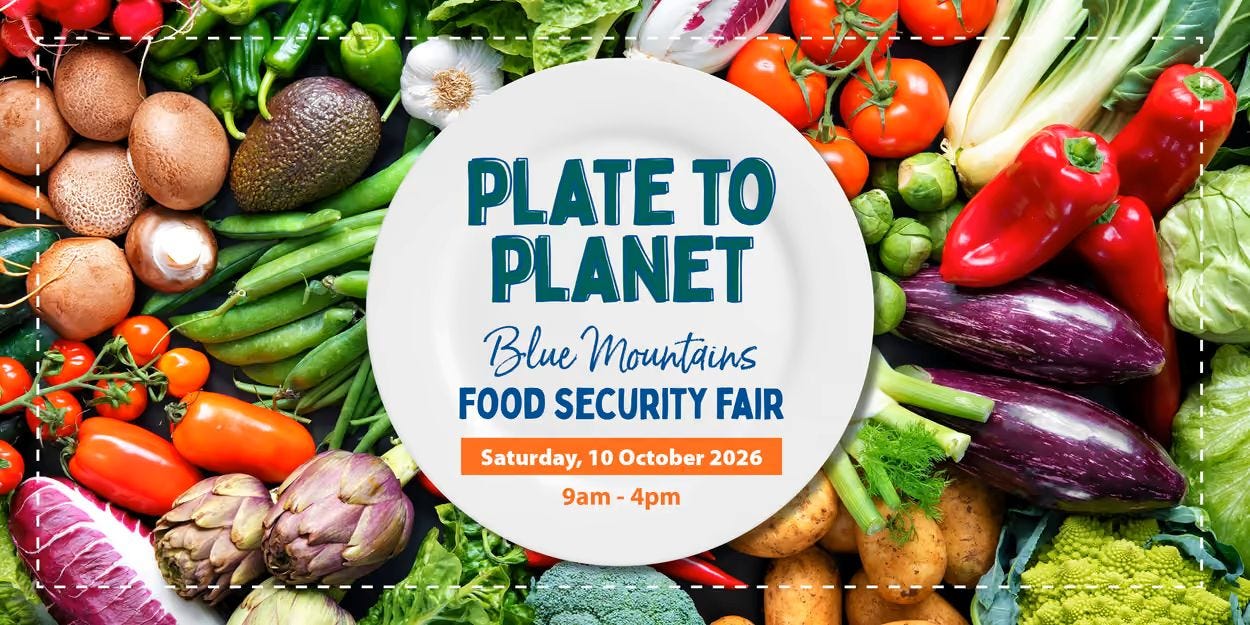
The free event, dubbed ‘Plate to Planet’, featured leading thinkers and practitioners presenting keynotes and workshops covering a wide spread of topics, including:
Headline talk: The age of renewable food - how we can feed everyone, bring peace & end extinction - Julian Cribb AM
How care-centred approaches to food can contribute to more equitable, regenerative & resilient communities – Manu Prigioni
The role of bioregions & how they can support food, water, energy, housing & community resilience – Rowe Morrow
Wild edibles foraging – Diego Bonetto
Home canning & food preservation – Kirsty Bertè
Permaculture garden design & community permaculture – Leni Nyssen and Jen Hall
Avoiding food waste, home composting & FOGO – Rob Morrison
Growing saltbush for protein diversification – Anne Elliott
The age of renewable food - how we can feed everyone, bring peace and end extinction
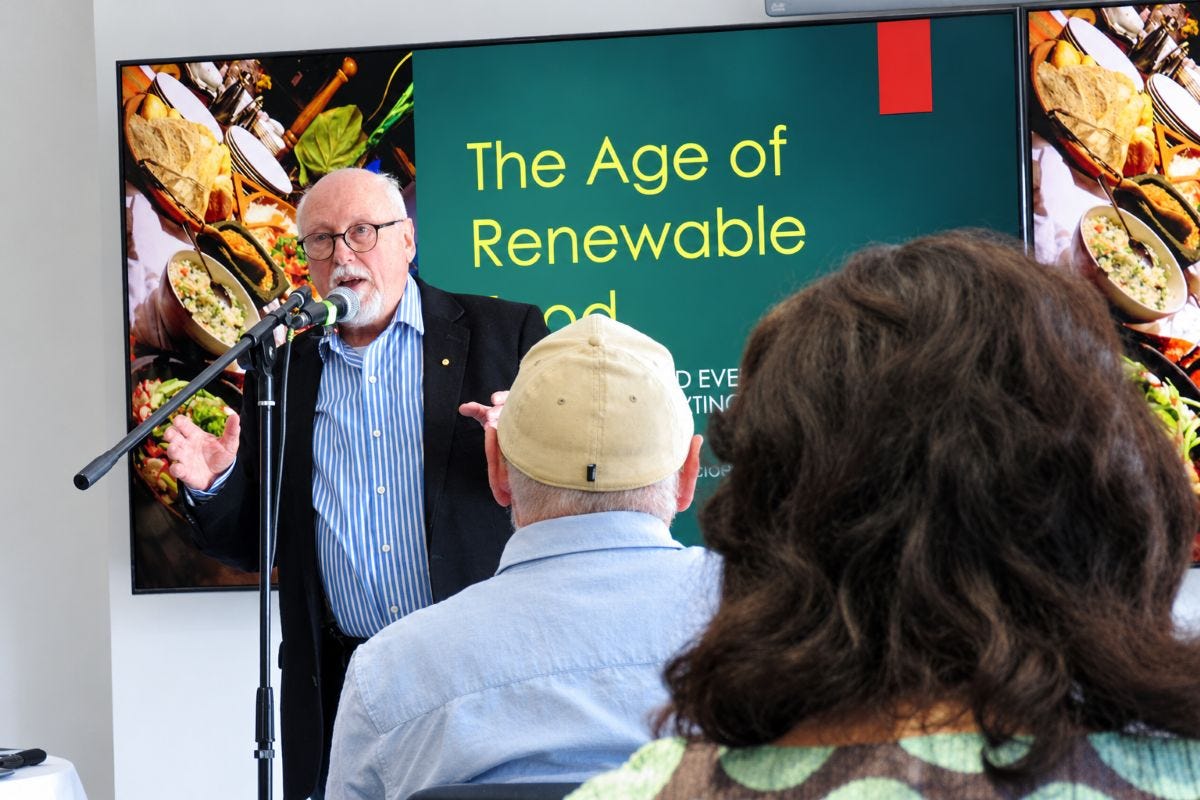
Julian Cribb delivers the headline talk at Plate to Planet
In his headline talk, Julian Cribb AM paints a concerning picture of the current and future state of our food security. Our current methods of food production are degrading and depleting soil, groundwater and entire ecosystems and this will only get worse as the population increases, with food requirements doubling by 2060.
The impacts are severe:
Food shortages have historically led to famines, mass migrations and wars
Food production contributes to climate change but is highly vulnerable to rising temperatures
Soil degradation and topsoil loss reduces productivity and necessitates use of chemical fertilisers
Pesticides and herbicides cause multiple health issues, many as yet unknown
Clearing native forests for more food production reduces biodiversity, leading to extinctions and contributing further to climate change
Renewable food, according to Julian, is the solution to feeding a growing population while taking care of planetary health.
What is renewable food?
Renewable food production avoids environmental depletion by actively restoring natural resources and regenerating the soil and water it uses. Julian identified three pillars of renewable food production:
Regenerative Farming – farming practices that follow natural and complementary principles to protect soil and water, sequester carbon, recycle nutrients and grow healthier food
Urban Food – Growing food for current and future megacities through high-tech closed loop systems and recycling water and nutrients within urban environments
Deep Ocean Aquaculture – By farming ocean fish and plants in the deep ocean, the negative impacts of on-shore aquaculture can be avoided, enabling the scaling up of production on a sustainable basis.
Explore more of Julian Cribb’s renewable food thinking here >
Care through food: facilitating just food systems transitions
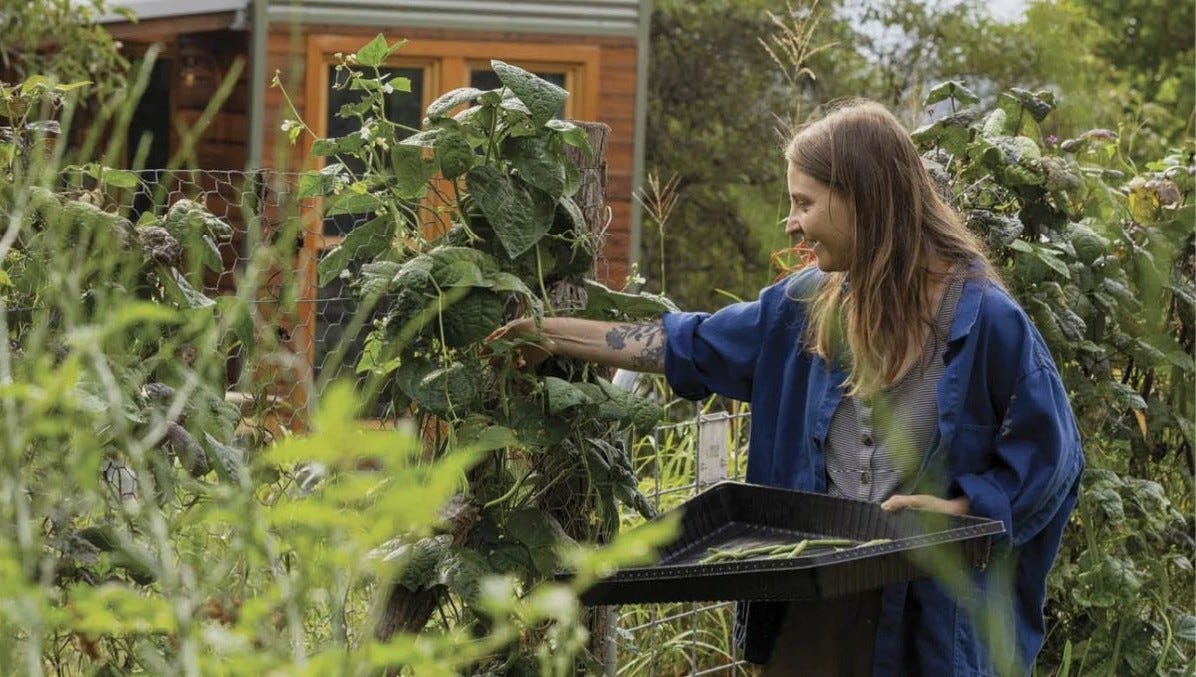
Manu Prigioni harvesting from her abundant garden (Image: Maja Baska)
Manu Prigioni is a co-founder of Farm It Forward, a community-led food-growing initiative in the Blue Mountains, and a PhD researcher with a focus on youth-led food initiatives and more equitable, sustainable food systems.
Her presentation explored how growing, sharing and preparing food can help create more equitable, caring and sustainable food systems. Drawing on her PhD research into youth-oriented community food initiatives across Australia, including her work co-founding Farm It Forward in the Blue Mountains, Manu examined how everyday food practices can foster belonging, collective wellbeing and planetary health.
A key concept was “mattering”: the experience of feeling valued by others while contributing meaningfully to a community. Manu explained how simple, repeated activities such as sharing meals, making tea and growing food together can meet multiple human needs, strengthen social connections and help people feel they belong.
Drawing on Manfred Max-Neef’s Human Scale Development framework, she highlighted how food can serve as a powerful connector, addressing not only nutritional needs but also our needs for identity, participation and connection.
Manu also emphasised that food insecurity is a systemic issue, requiring collective responses rather than placing responsibility on individuals.
It’s not up to the individual to fix systemic issues… there need to be approaches that are both bottom-up civic approaches like the ones that we are doing, and top-down approaches. - Manu Prigioni
She encouraged supporting local growers, strengthening existing community initiatives and creating opportunities for people to care for one another and the natural world as we work towards long-term social and ecological transformation.
The role of bioregions and how they can support food, water, energy, housing and community resilience
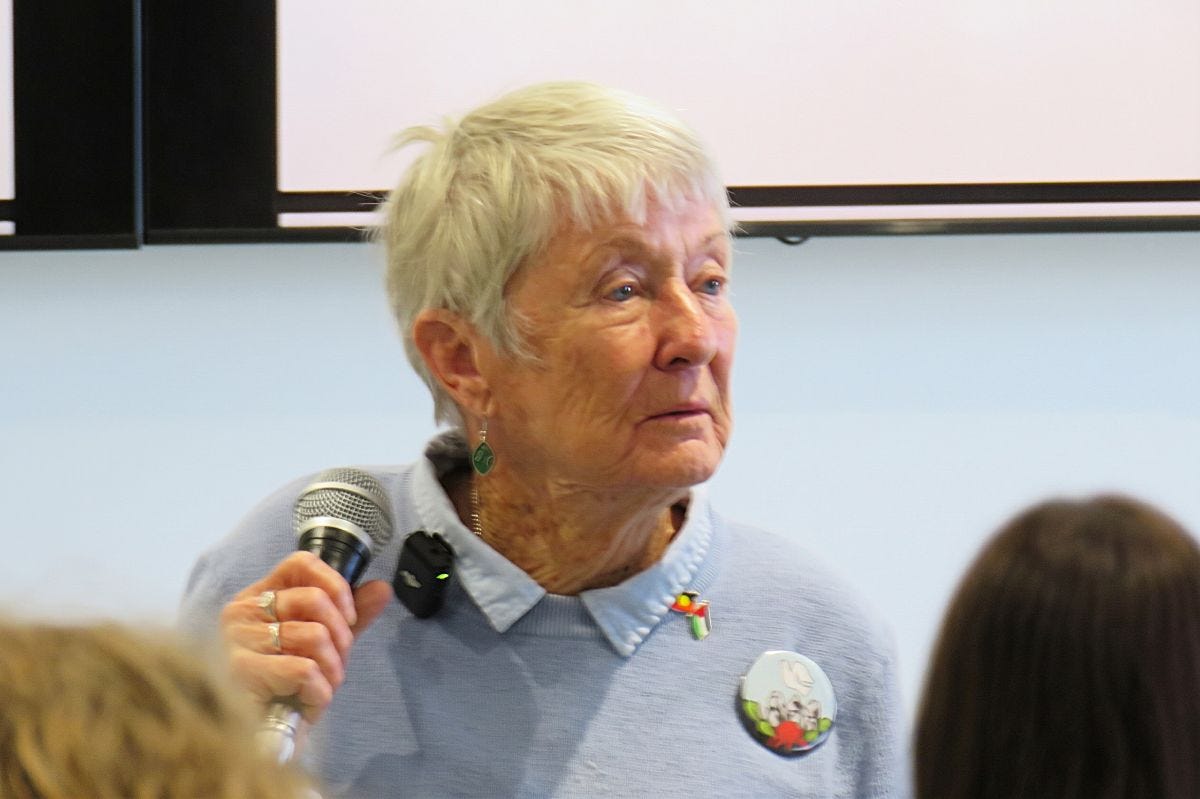
Permaculture educator and practitioner Rowe Morrow
Rowe Morrow’s presentation explored how understanding and strengthening our local bioregion can help communities navigate an increasingly uncertain future. Drawing on decades of international experience as a permaculture educator and practitioner, Rowe described a bioregion as a place shaped by its distinctive landscape, ecosystems, resources and communities.
She argued that the Blue Mountains bioregion could become more resilient by progressively meeting more of its own needs for food, water, energy, housing and other essential services, reducing dependence on vulnerable global supply chains.
Rowe emphasised the importance of living within ecological limits, protecting natural resources and building local systems that are circular, ethical and regenerative. Practical approaches included supporting local businesses and growers, keeping money circulating within the community, reusing materials, developing local lending and improving access to secure housing. She also highlighted the region’s often-overlooked strengths, including its social networks, arts, knowledge and community organisations.
Her central message was that building a resilient bioregion is a shared responsibility, not something to leave to governments or institutions. By making use of local resources, strengthening community connections and working together to meet collective needs, residents can help create a more sustainable and secure future for the Blue Mountains.
Wild edibles foraging
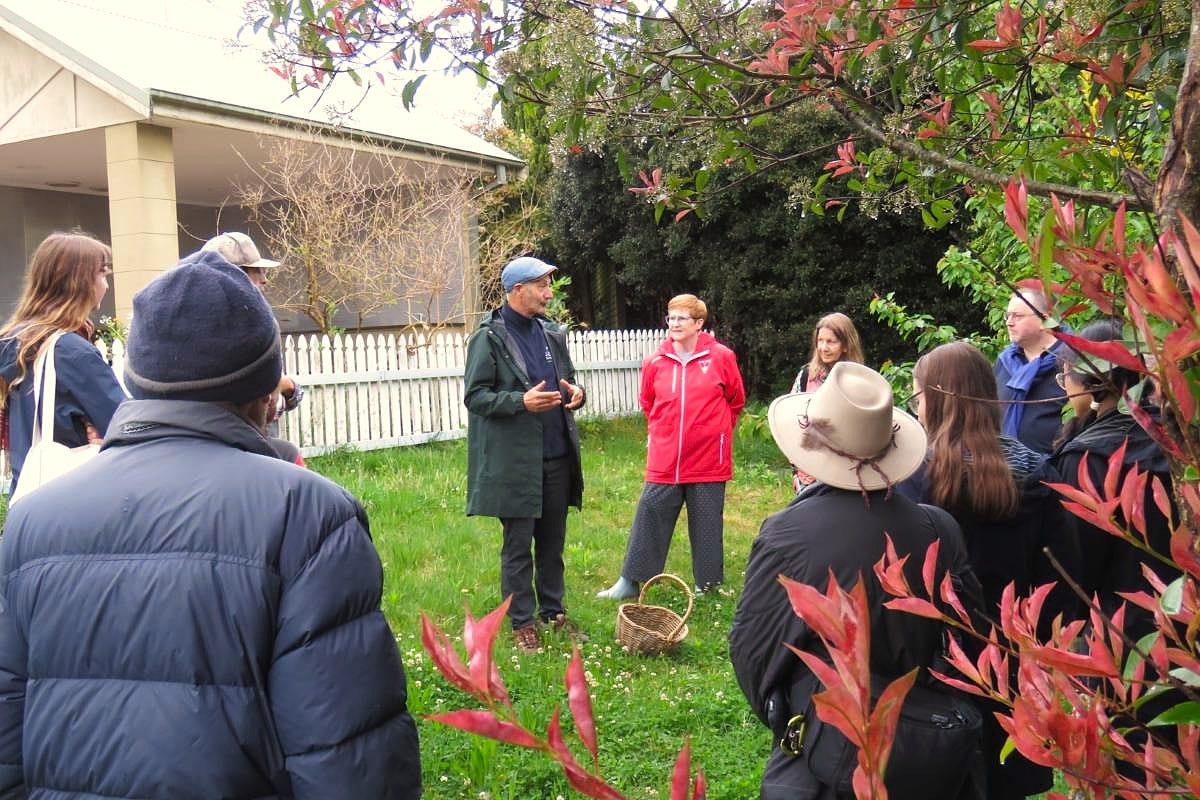
Diego Bonetto leading his workshop on foraging for wild edibles
Wild food is all around us as Diego Bonetto revealed in his foraging workshop on the day. Diego is a Lithgow-based wild food expert and author of ‘Eat Weeds’ who gained his passion for foraging growing up on a farm in Italy.
He led two groups of would-be foragers through the parklands of the Planetary Health Precinct to find and discuss species of edible and medicinal plants including Chickweed, Dandelion, Sow Thistle, Ironweed, Flatweed, Farmers Friend and Peppercress.
Diego shared the important role that weeds play in repairing and building soil, alongside their many current and traditional uses as food and natural remedies.
You can find out more about wild foraging, including lots of how-to guides, at https://www.diegobonetto.com/blog
Home canning & food preservation
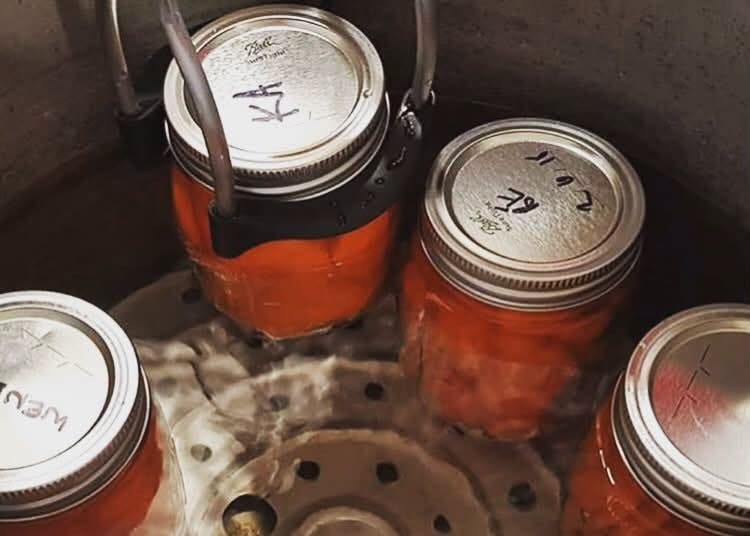
Carrots being added to a pressure canner for preservation at the workshop
Growing your own food is a fabulous thing, but it can be a case of feast or famine. Fresh food only stays fresh for so long, so a bountiful harvest needs to be eaten, shared or preserved to avoid going to waste.
Kirsty Bertè is the founder of Permaculture Hawkesbury Valley Inc and has over 25 years of experience in canning and preserving. In this workshop she took participants through:
How to safely preserve food using both water bath and pressure canning methods
Understanding the difference between high-acid and low-acid foods and how to preserve each
High-acid foods, including most fruits, are canned using the boiling water bath method and low-acid foods, like vegetables, meats, and soups, are canned with a pressure canner.
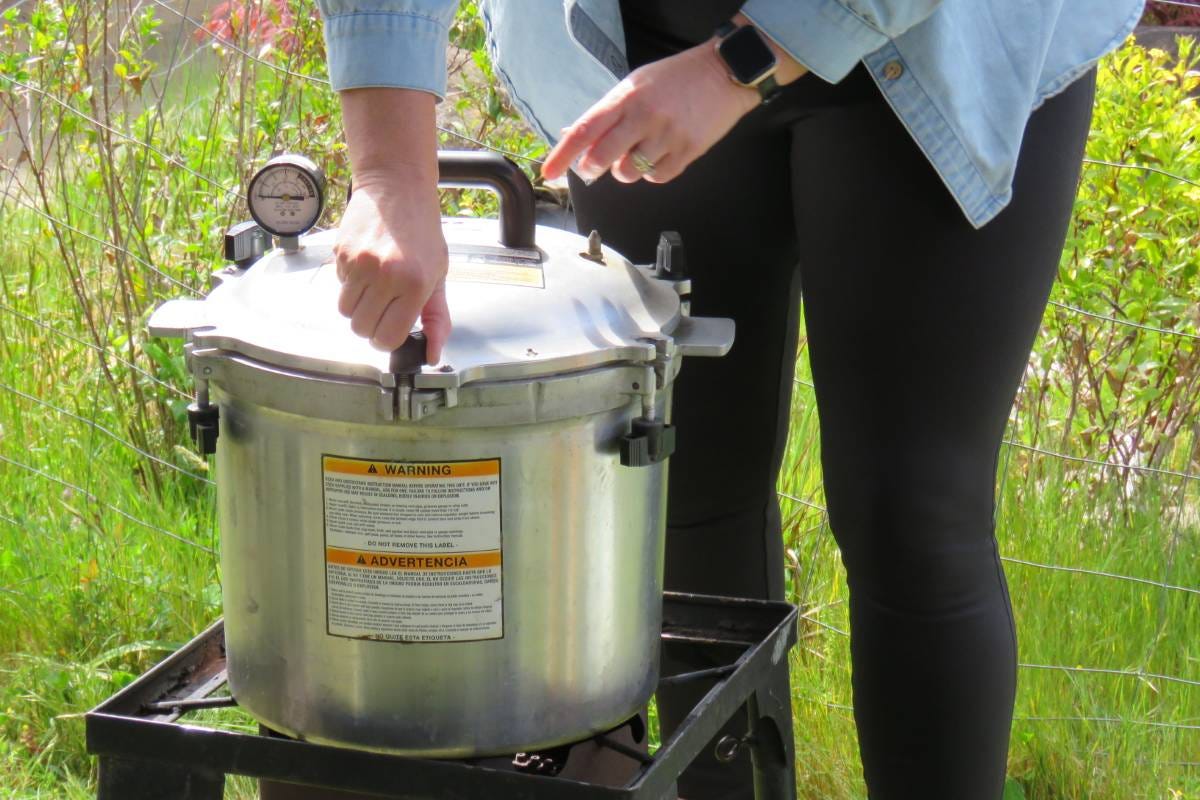
Kirsty sealing the lid on the pressure canner
Permaculture garden design and community permaculture
Two workshops on the day took participants through the principles of permaculture – a system of designing and managing land in a way that replicates natural ecosystems, protecting soil, water and biodiversity while producing abundant healthy food.
Garden design
In Leni Nyssen’s Permaculture Garden Design workshop, participants worked through a process that had them map out their own property against all its inputs and outputs, from energy like sunlight, to wind, fresh and grey water, organic matter and biomass. They were encouraged to see their properties as closed loop systems, where the output of one system becomes the input to another.
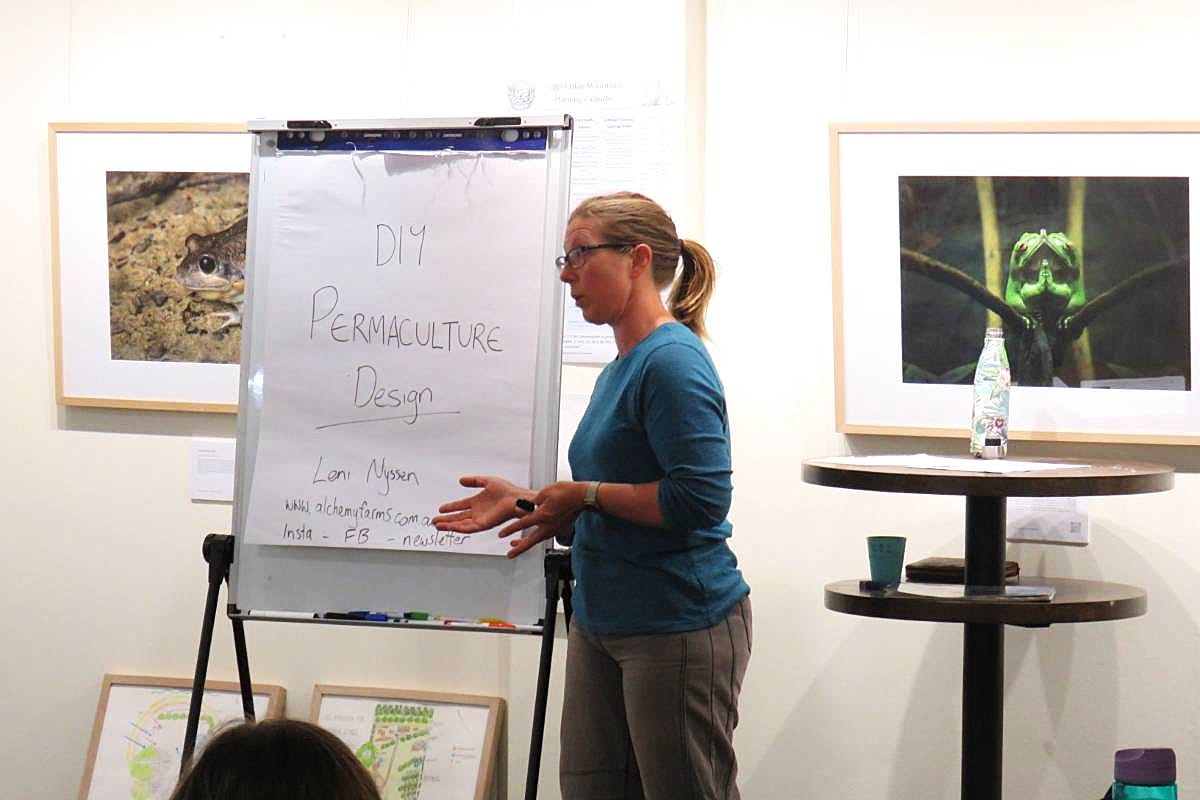
Leni Nyssen introducing the concept of permaculture to the workshop group
Many of the participants shared that they found growing food in the upper Blue Mountains challenging, with cold winters and abundant hungry wildlife in the warmer growing months. Leni explained how these principles can be put into play to better manage extreme weather and garden pests. Just one example – keeping chickens to devour garden pests along with food scraps, turning them into valuable fertiliser for the rest of the garden.
Community permaculture
Jen Hall’s workshop invited participants to consider how the principles of permaculture can be applied to communities as a way of building connection and resilience. Just as natural systems are deeply interconnected, communities and the people within them thrive with self-reinforcing connections.
From sharing harvests to sharing knowledge, this approach benefits all, with relationships growing together with the abundant crops a permaculture garden can produce.
Avoiding food waste, home composting & FOGO
Food waste is a huge problem – in Australia around a third of all the food we buy ends up as food waste. Recognising this, and the fact that 6,000 tonnes of food waste goes into domestic rubbish bins – and then to landfill – in the Blue Mountains every year, Blue Mountains City Council (BMCC) is introducing the Food Organics Garden Organics (FOGO) program in 2027.
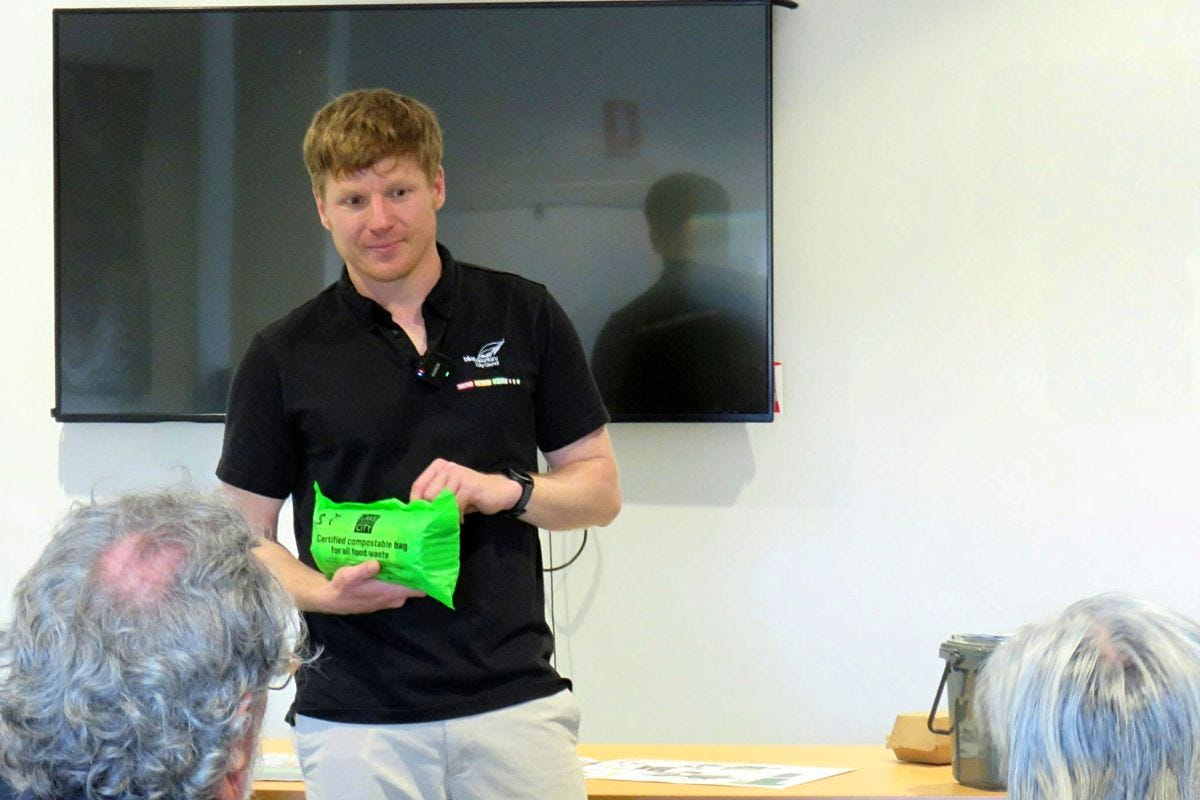
Rob Morrison presenting at the event
Rob Morrison, BMCC’s Manager, Sustainable Living, talked workshop participants through the program, making the important point that avoiding food waste in the first place is the ideal approach, followed by home composting and worm farms. For the rest, a weekly collection of organic waste will happen from mid next year.
In addition to vegetable scraps, the commercial composting system used can handle meat, dairy and even bones, processing it for agricultural use. You can learn more about the FOGO program here >
Growing saltbush for protein diversification
Our current systems for growing protein are incredibly inefficient. Animal-based proteins require far more energy input than they produce – for example, chicken, the most widely consumed meat in Australia, requires nine calories of feed to produce one calorie of meat.
As the world population continues to grow, alternate sources of protein are required. Saltbush can be one of them.
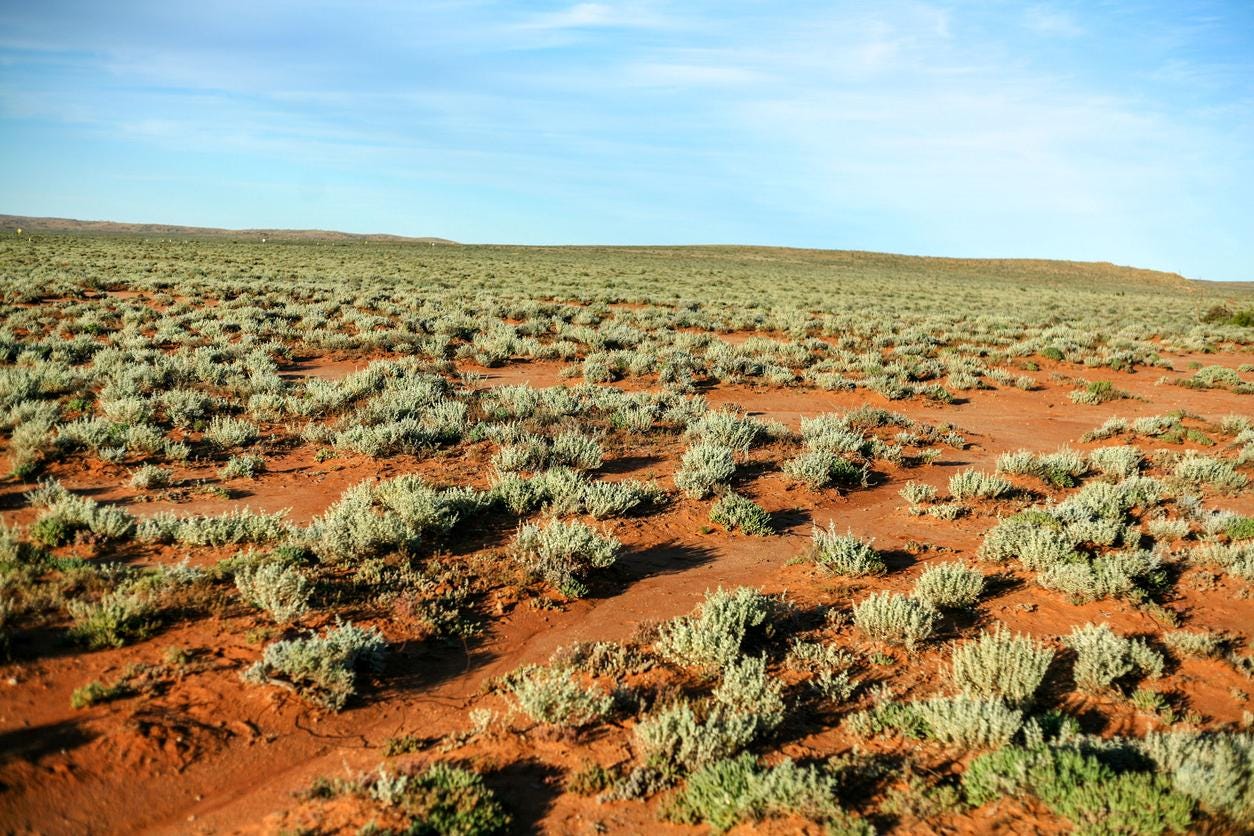
Saltbush growing at Silverton, NSW (Photo: Carla Edwards via iStock)
‘Old Man Saltbush’ (Atriplex nummularia) is an Australian native that thrives in arid and erratic climates. It has been part of the indigenous diet for millennia. It not only contains as much protein as soy, its amino acid profile closely matches human food requirements and is rich in calcium, iron, phosphorous and zinc.
Food educator and activist Anne Elliott ran a sold-out workshop on growing and preparing saltbush at home. It grows readily in pots and its dried leaves can be used to make a protein- and nutrient-rich powder for baking and many other uses, while the fresh leaves are great in salads, stir-fries and other recipes, with a herbal, earthy and lightly salty flavour.
Plate to Planet image gallery
Click any image to view full size


View all upcoming events at the Blue Mountains Planetary Health Centre: