
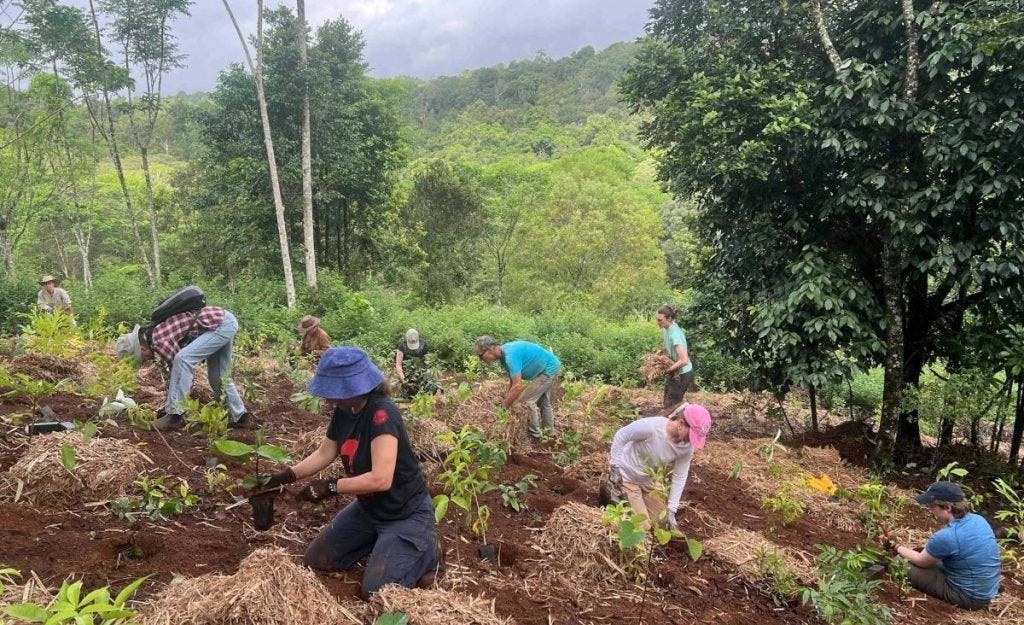
Habitat restoration is a long-haul job. Here are three groups that have endured

By Nigel Tucker, James Cook University
Like ferns and the tides, community conservation groups come and go. Many achieve their goal. Volunteers restore a local wetland or protect a patch of urban bush and then hang up the gardening gloves with a warm inner glow. Some groups peter out while others endure, tackling the ecological problems facing today’s Australia.
One of those problems is fragmentation. Let’s say you have a national park in one spot and another large tract of habitat ten kilometres away. It’s too hard for many wildlife species to make it across open ground to get there. Over time, this means wild areas can effectively become islands.
This is where habitat corridors come in. Potentially, if you restore habitat between two isolated areas, wildlife can begin to safely move between the two. Over time, these corridors allow seeds, pollen, native birds and animals to disperse across today’s landscapes.
In my work as a restoration ecologist, I’ve come across many of Australia’s community groups devoted to the job. Three of these are LUCI – Lockyer Upland Catchments Inc, which began in 2015, the Big Scrub Rainforest Conservancy, founded in 1993 and TREAT – Trees for the Evelyn and Atherton Tablelands Inc, which began in 1982. Each of these has gone the distance. Here are some reasons why.

Where are wildlife corridors most needed?
Australia’s Wet Tropics are especially threatened by fragmentation. This region is World Heritage listed due to its remarkable biodiversity. Tropical forests have grown here for at least 130 million years. Fragmentation directly threatens this.
In the tropical uplands of the Atherton Tablelands, there are three popular national parks – the Crater Lakes of Eacham and Barrine and the Curtain Fig Tree. But while visitors might see them as pristine, each is an island surrounded by pasture and settlement. Over time, this will take its toll on the species within.

Staying the course
For a volunteer group to reverse the effects of fragmentation, and embark on a long term project such as this, it needs three things.
First the group has leaders committed to a long term cause, usually scientists or naturalists as well as locals with knowledge and drive. Leaders have to be able to work with governments and group members of all persuasions.
Second, the group has to be guided by science. You need current information on local plants, animals and habitats to make sure on-ground work has direct conservation benefits.
And third, networking skills. Harnessing the technical expertise of other groups, government and experts in project planning, execution and monitoring is vital.
Each of these three groups has these traits, even though they take different approaches to the challenge.
LUCI is an alliance of private landholders in Queensland’s Lockyer Valley, west of Brisbane, who work to protect remnant vegetation and expand habitat. Their work on threatened species monitoring, protection of remnant vegetation on private land and community engagement reflects their emphasis on education.
Before European settlement, lowland subtropical rainforest covered 75,000 hectares of land in what is now Byron Bay’s hinterland. But 99% was cut down. In response, Big Scrub members have replanted around 600 hectares – doubling the size of what was left – and established an innovative genetics program to assist in maintaining and enhancing the gene pool of trees planted.

TREAT is based on the Atherton Tablelands in far north Queensland. This region has long been prized for agriculture, which comes at a cost to habitat. In response, TREAT has worked to reconnect isolated tracts of rainforest. The group collaborates with Queensland Parks and Wildlife to grow many thousands of native rainforest tree seedlings for planting each year.

All three groups recognise the importance of countering habitat fragmentation. This slicing and dicing forests into smaller and isolated patches severely threatens Australia’s biodiversity.
Wildlife corridors are deceptively simple in theory. But as I know from long experience restoring habitat, it’s harder than it seems.
Does it work?
Planting corridors sounds like a sure thing. But success is not guaranteed. For one thing, it takes work and time. You need baseline surveys, expert analysis of data and monitoring, ideally over decades. Given these challenges, it’s unsurprising that wildlife corridor restoration is little-studied.
In the 1990s, TREAT volunteers planted 17,000 trees to reconnect a 498 hectare fragment around Lake Barrine to the 80,000ha Wooroonooran National Park 1.2 kilometres away. This corridor is now more than 20 years old. It’s known as the Donaghy’s Corridor Nature Refuge, after the Donaghy family who donated the land for corridor restoration.
My research has found this corridor is proving successful, using good data collected before, during and after establishment. Ground mammals are moving along the corridor, and breeding has taken place. We could see this in the exchange of genes between two previously separated populations of the native bush rat (Rattus fuscipes).
More recent studies have shown the corridor has been colonised by many species, ranging from threatened and endemic plants to birds, ground mammals, reptiles, amphibians and microbats. While promising, this is just one corridor. Much more data would be needed to prove this approach is broadly effective.
As habitat fragmentation continues and the effects of climate change ramp up, more and more species will need to move. The work of volunteer groups such as LUCI, Big Scrub and TREAT in reconnecting scattered pieces of habitat is only going to get more important.
Nigel Tucker, Research Associate in Environment and Sustainability, James Cook University
This article is republished from The Conversation under a Creative Commons license. Read the original article.
Share this article:
Share
More from around the region

bluemountainsplanetaryhealth Dec 6
@ bluemountainsplanetaryhealth . Dec 6
Open post by bluemountainsplanetaryhealth with ID 18087414430823459
We had a thoroughly enjoyable final Skill Share Saturday for the year yesterday with Qigong, Fashion Upcycling, Seed Saving and Bushcare!
We shared seeds from local gardens and harvested carrots, as well as Mizuna, Broad Bean, Daikon and Land Cress seeds from the Planetary Health garden. We then packaged up (and shared) our first Upper Mountains Seed Savers packs for our fledgling Seed Bank.
In Bushcare it`s very exciting to see whole new areas of the Planetary Health Precinct open up as we remove invasive weeds. It`s been a year of great progress as we`ve restored habitat for wildlife and given local native plants the opportunity to flourish and re-establish on the site.
#skillshare #skillsharesaturday #seedsaving #bushcare #planetaryhealth #community ...
17 0

bluemountainsplanetaryhealth Dec 3
@ bluemountainsplanetaryhealth . Dec 3
Open post by bluemountainsplanetaryhealth with ID 18089921119749361
Join the Planetary Health Centre this Sat 6 Dec for the last Skill Share Saturday of the year: Qigong at 9am, Seed Saving & Gardening Group at 10am, and Bushcare at 1.30pm. One perfect day with great company, great coffee and food, and great steps for living a healthy balanced life, while also contributing to the health of our planet for present and future generations. All ages welcome!
Registration links in profile and below.
Register for Qigong here: https://bit.ly/48wlHjD
Register for Seed Saving & Gardening here: https://bit.ly/4prcRe7
Register for Bushcare here: https://bit.ly/4oAFDrz
#qigong #bushcare #seedsaving #gardening #community #selfcare #planetarycare #healthcare #planetaryhealth #katoomba #bluemountains ...
10 0

bluemountainsplanetaryhealth Nov 27
@ bluemountainsplanetaryhealth . Nov 27
Open post by bluemountainsplanetaryhealth with ID 17933389716129642
We have a rare opportunity to learn about the newest and best possible ways to support family and community members struggling with mental health issues, at a free talk and afternoon tea provided by Upper Blue Mountains Sunrise Rotary at the Planetary Health Centre at 2pm this Saturday 29 Nov. Hear from Peter Joseph AM, Chair of the Black Dog Institute, and Professor Helen Christensen AO, Fellow of the Australian Academy of Science and former Executive Director and Chief Scientist at the Black Dog Institute. They`ll be in conversation with journalist Emma Rossi. Dr Christensen is a pioneer in using the internet to reach young people struggling with depression. Her digital mental health interventions are used by millions globally, delivering evidence-based therapy for depression, anxiety, and suicide prevention. Her research uses data from smartphones and wearables – like movement, screen use, and sleep – to detect early signs of mental health issues. Bookings essential here (link in profile): https://bit.ly/4oOnYxz
#mentalhealth #suicideprevention #blackdoginsstitute #planetaryhealth #katoomba #bluemountains
@lifelineaustralia @blackdoginst ...
8 1

bluemountainsplanetaryhealth Nov 26
@ bluemountainsplanetaryhealth . Nov 26
Open post by bluemountainsplanetaryhealth with ID 18040613594701839
This Saturday Sherlie McMillan from Rotarians 4 Planetary Health will be running a workshop on How to use a sewing machine from 9am at the Planetary Health Centre in Katoomba. Learn how to set up a machine, service it, troubleshoot when it`s not sewing correctly, and learn some basic sewing skills.
Bookings essential here (link in profile):
https://events.humanitix.com/how-to-use-your-sewing-machine
NB. This class is a prerequisite for our very popular Fashion Upcycling classes held once a month.
#howtosew #fashionupcycling #repair #reuse #towardszerowaste #planetaryhealth #katoomba #bluemountains ...
17 0

bluemountainsplanetaryhealth Nov 25
@ bluemountainsplanetaryhealth . Nov 25
Open post by bluemountainsplanetaryhealth with ID 17858701182492411
We`re thrilled to announce that Professor Helen Christensen, a pioneer in using the internet to reach young people struggling with depression, will be joining the conversation with Peter Joseph AM from the Black Dog Institute and journalist Emma Rossi at the Planetary Health Centre at 2pm this Saturday 29 November. Helen was the Executive Director and Chief Scientist for the Black Dog Institute for 10 years and has now been elected a Fellow of the Australian Academy of Science. Her digital mental health interventions are used by millions globally, delivering evidence-based therapy for depression, anxiety, and suicide prevention. Her research uses data from smartphones and wearables – like movement, screen use, and sleep – to detect early signs of mental health issues.
This free event is being co-hosted by Upper Blue Mountains Sunrise Rotary and the Blue Mountains Planetary Health Initiative. Afternoon tea will be provided. Bookings essential here (link in profile): https://bit.ly/4oOnYxz
@rotary_club_lower_blue_mtns @rotaryclubofnepean #mentalhealth #rotary #planetaryhealth @black_dog_institute ...
8 2

bluemountainsplanetaryhealth Nov 24
@ bluemountainsplanetaryhealth . Nov 24
Open post by bluemountainsplanetaryhealth with ID 18078394361144632
Human composting is increasingly being legalised around the world. Read about it in Katoomba Area Local News here (link in profile): https://www.katoombalocalnews.com/legalising-human-composting/
If you’d like to see this option available in NSW you can now sign a live petition to the NSW Parliament here (link in profile): https://bit.ly/43QIHbz
#humancomposting #greenburials #katoomba #bluemountains #planetaryhealth ...
17 0

bluemountainsplanetaryhealth Nov 22
@ bluemountainsplanetaryhealth . Nov 22
Open post by bluemountainsplanetaryhealth with ID 18064732544157559
Thanks to everyone who contributed to deliver a fantastic Disaster Risk Awareness Expo and Family Day yesterday. @mark_greenhill_mayor opened the event at which we celebrated the 13th birthday of Betty the Asbestos Education House; @firecoat_au demonstrated and launched its range of fire retardant products that can help protect homes, gardens and even electricity poles; the Bushfire Retrofit Toolkit was launched; Santa arrived and delighted young and old; and @plantinspired99 and Action for Animals fed us all with a delicious plant-based sausage sizzle. The day was filled with talks, workshops, stalls and the sharing of a huge amount of expertise to keep us, and the other species we share our planet with, safe and healthy! @southkatoomba.rfb @nswses @fireandrescuensw @nswrfs @redcrossleura @redcrossau @shelter.building.design @firehalo.au @asbestosawareness @amelie_ecology @bbagsbluemtns @wireswildliferescue @handsheartfeet
#disasterriskawareness #disasterriskreduction #familyday #planetaryhealth #katoomba ...
22 2

bluemountainsplanetaryhealth Nov 20
@ bluemountainsplanetaryhealth . Nov 20
Open post by bluemountainsplanetaryhealth with ID 17931271275134070
Our marquee is up and we`re excited about our Expo and Family Day tomorrow (Sat 22 Nov). There`s something for everyone from a free sausage sizzle, plants from Santa and drumming and pollinator workshops, to sessions on keeping you and our community safe from extreme weather events and hazardous substances like mould and asbestos. Learn how intumescent paints can slow the spread of fire and pick up a sample pot; check out all our emergency service organisations; learn how to dispose of hazardous materials; paint a native orchid, make some seed balls or sew a boomerang bag to give as plastic-free Christmas presents this year; enjoy coffee and locally made sweets; and get tips on how to retrofit your home safely and beautifully to be prepared for future extreme weather events. View the full program and register here (link in profile): https://bit.ly/4nFrY1J
#disasterriskawareness @asbestosawareness @SES @southkatoomba.rfb @wireswildliferescue @redcrossleura @shelter.building.design @amelie_ecology @handsheartfeet @bbagsbluemtns @firecoat_au ...
12 0

bluemountainsplanetaryhealth Nov 19
@ bluemountainsplanetaryhealth . Nov 19
Open post by bluemountainsplanetaryhealth with ID 17899449090181264
There are so many new and innovative ways of doing things, like the new cooking techniques being explored by Michael from Good Fat Pastry, and the new fire protection methods being launched at the Planetary Health Centre`s Expo and Family Day on Sat 22 Nov. Check out Michael’s recent presentation at the Food Security Fair in our video here: https://bit.ly/4pnXbIg (link in profile) and come along to taste his delicious carrot cake and pastries at the Expo on Saturday. Check out the program and register to attend here (link in profile): https://bit.ly/4nFrY1J
#plantbased #vegan #glutenfree #innovation #planetaryhealth ...
30 0

bluemountainsplanetaryhealth Nov 19
@ bluemountainsplanetaryhealth . Nov 19
Open post by bluemountainsplanetaryhealth with ID 18141125962452869
In 2006 Peter Joseph’s son Michael suicided after a 14-year episodic battle with mental illness. Peter is now the Chair of the Black Dog Institute which is working to achieve better outcomes for all those struggling with mental health issues. Journalist Emma Rossi will engage Peter in an intimate and moving conversation about a life of purpose and mental health advocacy. As a Rotary scholar Peter will also reflect on how Rotary helped shape his values and sense of purpose as a young man - and how those early lessons continue to guide his work today. This free event is being hosted by the Upper Blue Mountains Sunrise Rotary Club and the Blue Mountains Planetary Health Initiative on Saturday 29 November from 2-4pm at the Planetary Health Centre at 33-39 Acacia St Katoomba. Afternoon tea will be provided. Bookings essential here (link in profile): https://bit.ly/4oOnYxz
@black_dog_institute #mentalhealth #suicide #purpose #advocacy #peterjoseph #emmarossi #conversation #planetaryhealth #katoomba
@rotaryaustralia @rotary_club_lower_blue_mtns @rotary9675 @rotarykatoomba ...
9 2

bluemountainsplanetaryhealth Nov 18
@ bluemountainsplanetaryhealth . Nov 18
Open post by bluemountainsplanetaryhealth with ID 17870682795464443
Learn about intumescent fire retardant paint and a range of other strategies to prepare for extreme weather events, and to manage hazardous materials, at the upcoming Expo and Family Day at the Planetary Health Centre on Sat 22 Nov. You can register to attend here (link in profile): https://bit.ly/4nFrY1J
We checked out how intumescent paint works in this video.
When temperatures reach a certain point the intumescent paint begins to swell and expand, often up to 50 times its original thickness. It forms a thick, carbonaceous "char" that acts as an insulating barrier. This layer slows the rate at which heat reaches the structural elements and buys valuable time for people to safely exit a building during a fire. It makes the structure safer for firefighters and rescue teams.
#intumescentpaint #fireretardant #bushfire @firecoat_au ...
7 0

bluemountainsplanetaryhealth Nov 17
@ bluemountainsplanetaryhealth . Nov 17
Open post by bluemountainsplanetaryhealth with ID 18079709189154464
Mould, lead paint, asbestos, silica dust from engineered stone bench tops and a wide range of chemicals, are amongst some of the many hazardous substances entering our environment and negatively impacting our health. Asbestos is found in over 3000 products including textured paints, moulded garden pots, brake pads and clutch linings in older cars, floor and ceiling tiles, lino, fibro, roofing, pipes and gutters, hot water systems, backing for switchboards and insulation boards in air-conditioning ducts, insulation, sealants, fillers, caulking and adhesives, gaskets for industrial and lab equipment and more. We’ll have information to take away and Blue Mountains City Council and the Asbestos and Hazardous Materials Consultants Association (AHCA) will be running free workshops on how to identify and manage these hazardous substances at the Planetary Health Centre`s Disaster Risk Awareness Expo in Katoomba on Sat 22 Nov. Find out more and register to attend here (link in profile): https://bit.ly/4nFrY1J
#asbestos #mould #silicadust #chemicals #hazardousmaterials #beaware #besafe #planetaryhealth #katoomba #expo #bluemountains ...
9 0
Load More Follow on Instagram
The post Habitat restoration is a long-haul job. Here are three groups that have endured appeared first on Planetary Health News.


